
Unlike the other sections of this blog, this section has almost no history. As far as experimental archaeology goes, I think I might be the only person in Rhode Island actively doing these kinds of projects. Aside from Flintknapping, of which I am aware of 3 others in the state who do it, ceramics, basketry, ground-stone tools, and agriculture are all things that I am only aware of myself doing.
Experimental archaeology is the attempt to test hypotheses about archaeological ideas, most frequently relating to objects. The definition of object is difficult, but in this case we will them artifacts. It does differ from the recreation of artifacts, but there are ways they overlap. It is my opinion that the experience of producing an artifact gives even more insight than using an artifact. A stone axe made on a diamond polishing wheel is not the same as an stone axe polished and ground by hand, the pressure, the time involved, and the level of finish you are able to achieve are different. I think it is in an important part of the education for those interested in material archaeology to understand the process of production (often written as Chaine operatoire). I want to make it very clear, what I am doing is not very much of science, and is likley closer to art. I hope one day to do work closer to science.
It is also very important to note two things
1- I make none of these things for financial profit. With the exception of some tools that are were so common that no group can claim cultural authority over them, like bifaces or ground stone axes, almost none of these artifacts come from groups I claim any descendancy form. These artifacts do not belong to my ancestors or my culture, and I should not experience any financial gain from it. Material gain is different, as when I do meet others who work on projects like these, we exchange materials or completed artifacts.
2- I try my best to not recreate culturally sensitive artifacts. This often means avoiding specific designs, and asking for permission to do particular styles in some art. It must be kept in mind that designs or styles were often earned in their original cultural contexts, often through initiation rites. For example, I will never make something like a kachina, or a Tlingit spirit catcher box, as I do not have the necessary culturally knowledge to recreate those objects in good faith.
Agriculture
I have been working on experimental archaeology in agriculture since a bit before covid, when I started growing Wilda Corn in my yard. I had done this only to see if I could grow corn there, and added a lot of pottery sherds form my personal work and burnt sea shells for the purpose of adding lime, mimicking a shell midden. There is not much to say about this other than almost no corn grew.
In 2022, I started a new project, growing corn in the woods behind my house, which we will call the Violet Mountain area. The first step was selecting a location to grow the corn. The top of Violet Mountain is a small plateau that is has far fewer trees than the lowland area.
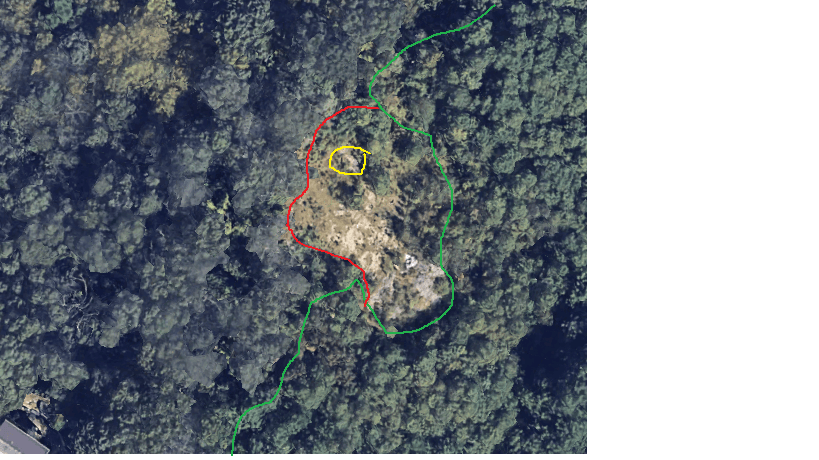
The green area is the lowland, which was clear cut in 2013-2014, the red area is the plateau, the uncolored area is the older forest, and the yellow circle was growing area one.
 Rhode Island Naturalism