
Paleontology is an unloved branch of naturalism in Rhode Island. As of 2025, the only paleontological work being done here is quaternary palaeoclimatological work. Rhode Island lacks almost any Mesozoic formations, with the exception of Cretaceous era Raritan formation clays on Block Island. On Block Island there is some Cenozoic material, but the Paleozooic dominates the available fossil bearing localities. On Conanicut Island in Jamestown, there is some Cambrian material, but by far the most common fossils in Rhode Island are Carboniferous era. This era is also what most fossil hunters in the state are looking for, including the Author/Artist Steve Emma, who’s personal guidance and book were essential to building my knowledge of Rhode Island’s Paleontology.
History of Rhode Island Paleontology.
1880s
The earliest known western paleontological work in Rhode Island was done by Reverend Edgar F. Clark in the 1880’s, who was seemingly based in Pawtucket. He was the contemporary of two other fossil hunters, both young at the time, Herbert Arthur Schofield, who was around 8-11 at the time of collecting most of these fossils, and Frederic Poole Gorham, who would have been 17-21 (Herbert Arthur Scofield (1881–1939).” FamilySearch, Frederic Poole Gorham (1871–1933).” FamilySearch). At the more professional level, the then Brown Professor Alpheus S. Packard was being given fossils by the young men and the Reverend, who gave them to the writer of Rhode Island’s earliest paleontological report, Paleontologist and Entomologist Samuel Hubbard Scudder. The first report, dealing exclusively with insects, Insect Fauna of the Rhode Island Coal Field, 1893, lists the following localities and genera (Scudder, Samuel Hubbard. Insect Fauna of the Rhode Island Coal Field. U.S. Geological Survey, Bulletin 101, 1893),
It is very much likely that there are earlier published materials about the plant fossils from Rhode Island, but until such time as I find them, this is the date we are going with.
Below is a table describing the insect species of the area.
| Town | Locality | Taxon | Finder |
|---|---|---|---|
| Bristol | General | Mylacris packardii | Clark |
| Cranston | Fenners Ledge | Etoblatina sp. | Gorham & Schofield |
| Cranston | Lockonosett Mine | Rhaphidopsis diversipenna | Clark |
| East Providence | General | Etoblatina scholfeildi | Schofield |
| East Providence | Kettle Point | Etoblattina exilis | Schofield |
| East Providence | Silver Spring | Etoblatina sp. | Schofield |
| East Providence | Silver Spring | Gerrablatina fraterna | Schofield |
| East Providence | Silver Spring | Paralogus aeschnoides | Gorham |
| Pawtucket | General | Anthracomartus woodruffi | Clark |
| Pawtucket | General | Etoblatina clarkii | Clark |
| Pawtucket | General | Etoblatina gorhami | Gorham |
| Pawtucket | General | Etoblatina illustris | Clark |
| Pawtucket | General | Etoblatina requia | Schofield |
| Pawtucket | General | Etoblatina sp. | Schofield |
| Pawtucket | General | Gerrablatina sculptularis | Schofield |
For the entirety of the state, that looks like this, with dots representing quantity of genera per town.

For the two towns with localities named, East Providence and Cranston, the localities are placed accurately
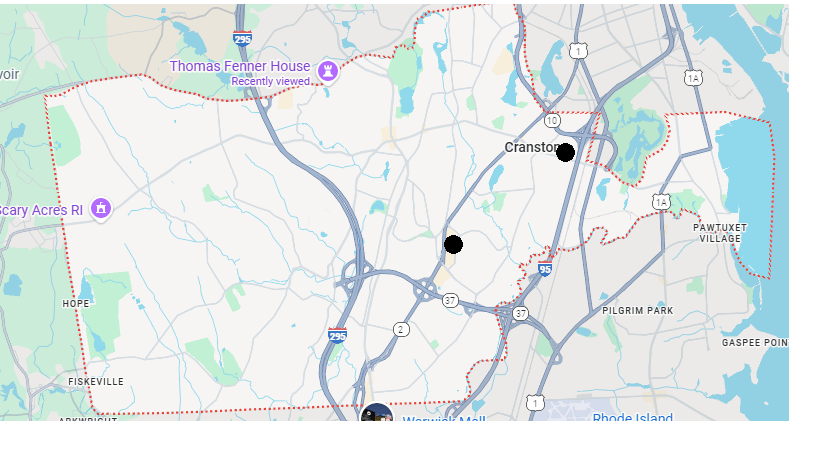
In Cranston, the two localties are under what is now Garden City center to the South, and the second is a still exposed ledge next to an Aldis on 1015 Cranston Street, information I would not have known if not for the great website Strange New England, which is very much worth checking out (https://www.strange-new-england.com/2017/04/13/deadmans-cave/#more-918)

In East Providence, Kettle Point still remains an accessible location, however Silver Spring no longer exists, though it may be on the location of Silver Spring Elementary School
1908
In 1908, the tunnel underneath College Hill down to Fox point, known as the East Side Railroad Tunnel, was constructed for the sake of a train system that connected Fall River to Providence and all the way to New York. The tunnel itself is “22 feet high, 31 feet wide, 5,080 long”, and required the excavation of 200,000 yards of material” (“East Side Train Tunnel.” ArtInRuins, 10 Aug. 2024). If you’d like to learn more about how our beautiful capital once had a fully functioning rail line that offered a lovely alternative to the now semi-gridlocked highways that cut it in half, please visit the ArtinRuins website.
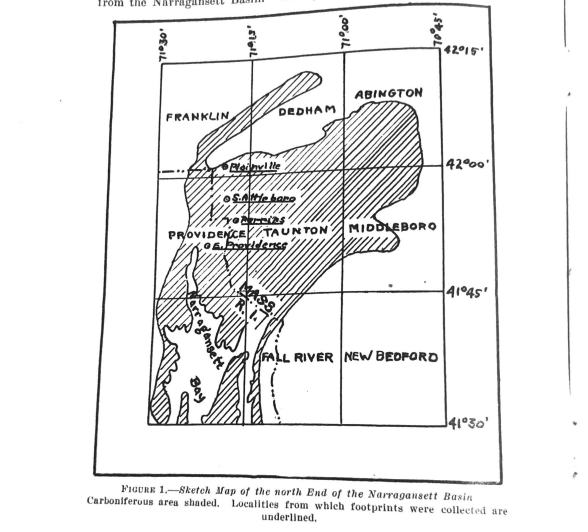
Following this map from the booklet “Amphibian Footprints from the Pennsylvanian of the Narragansett Basin” by Bradford Willard and Arthur B. Cleaves, the area which the tunnel cuts through is directly adjacent to an area where amphibian footprints have been found, as well as Reverend Clark’s insect fossils. From this, we can reasonably conclude that the fill from the tunnel was fossiliferous.
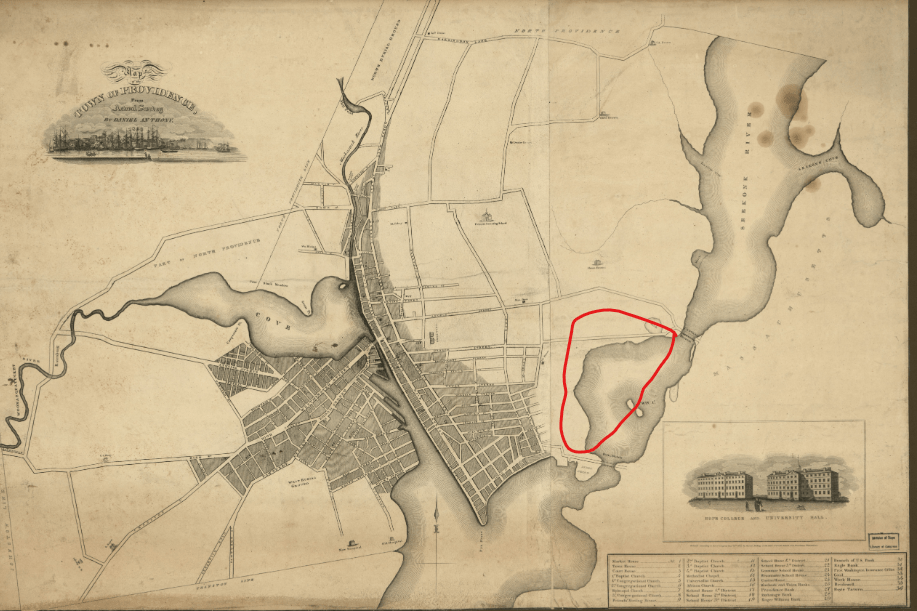
Here is what Providence looked like in 1823, with the area of Gano Park highlighted. as can be seen here, it was a decently sized cove at the time. (Map of the Town of Providence: From Actual Survey. 1823. Wikimedia Commons,
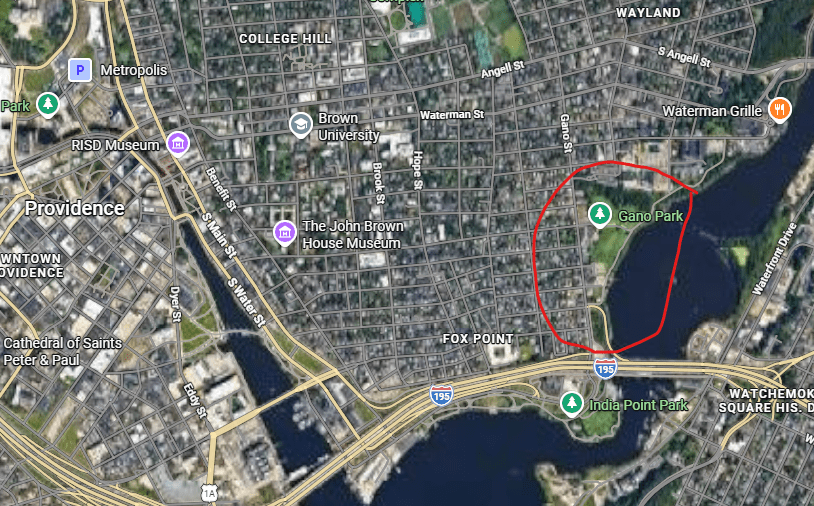
And here is Providence today, 2026, with what is noticeably not a Cove.
I would guess that much of this cove was filled in by the material from the East Side Train Tunnel.
I have personally found black shale with high quality leaves from the slopes right by the side of Gano Street Park when I was younger. Hopefully either you or me will take a more investigative look at the area and see what we can find.
1914
In 1914 the city of Providence constructed the East Side Trolley Tunnel, for the trolley system that ran between East Side and Market Square, as College Hill was too steep to ascend for ordinary trolleys at the time. According to Marian Murray’s “Hunting for Fossils”,
“Brown University has a large collection of plants, many of which were found when a car tunnel was made in 1914 through College Hill.”
Most of these specimens must have been housed in the Jenks Museum of Natural Science and Anthropology. In 1945, most of the contents of this museum were “transferred to university dump on the banks of the Seekonk River” (Benedict, Lily. “The Lost Museum.” Brown 250, Brown University).
Unfortunately, the site of the dump is unknown, and may well be underwater, or fully picked through by other interested people. Some of the fossils were moved to the Roger Williams Museum at the border of Cranston and Providence, though how many is not something I have checked into yet.

