
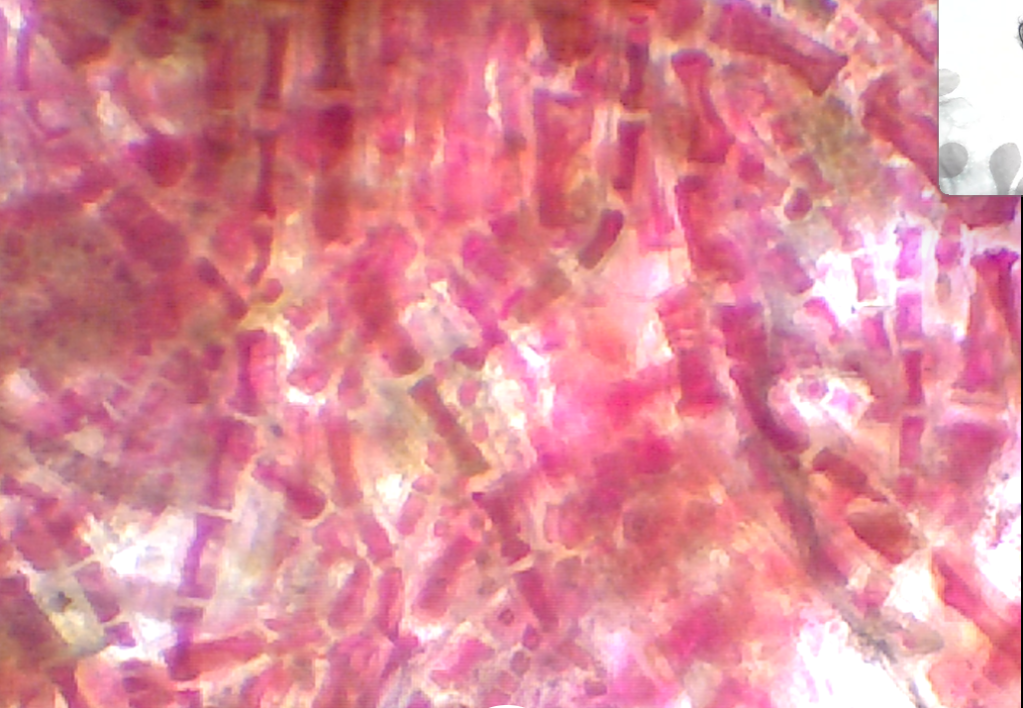
- Image above, Red algae taken at 400x Mag.
Overview
Phycology is the study of Algae, which are any photosynthetic organisms that are not plants (Viridiplantae). The main groups of Algae are Cyanobacteria, Red Algae (Rhodophyta), Green Algae (Chlorophyta), and the Brown Algae (Phaeophyta). These are the groups with the most macroscopic members, as well as the ones that are most consistently photosynthetic. In the minor groups, sometimes only a single genera may be photosynthetic (Such as Chromera velia in the Apicomplexa, though this is complex), or, a single genera may be photosynthetic for only part of it’s lifecycle (see Hatena arenicola and Nephroselmis) (Oborník, Miroslav et al. 2010, Okamoto, Noriko, and Isao Inouye, 2010). These minor groups include the Euglenophyta, Dinoflagellates (Dinophyta), Cryptophyta, Prymnesiophyta, and many groups within the Heterokontophyta, including the previously mentioned Phaeophyta (Lee, Robert Edward, 2008).

Image by Adl et al. (2012), from Ponce, Rafael & Lopez-Garcia, Purificacion & Moreira, David. (2019). Horizontal and endosymbiotic gene transfer in early plastid evolution. New Phytologist. 224. 10.1111/nph.15965.
Algae are an inherently polyphyletic group, meaning that that not everything that is called an Alga (singular form of Algae) is related to any other algae. in some cases they are not related at all, aside from being life.
The most basal algae are cyanobacteria, gram-negative bacteria whose earliest fossils date from around 1.75 billion years ago, from chert in Australia (Demoulin, C.F., Lara, Y.J., Lambion, A. et al. Oldest thylakoids in fossil cells directly evidence oxygenic photosynthesis. Nature 625,). They are extremely common organisms, found on every continent and seemingly anywhere there is freshwater, and even within rock. They can grow as filaments, or as singular bacterium, and often species do both strategies (photo to come). They, as far as we know, are the earliest oxygenic photosynthesizers, as in organisms that use oxygen in the process of photosynthesis. They are are also responsible for the earliest large organic structures as well, in the form of stromatolites, sedimentary rock struc
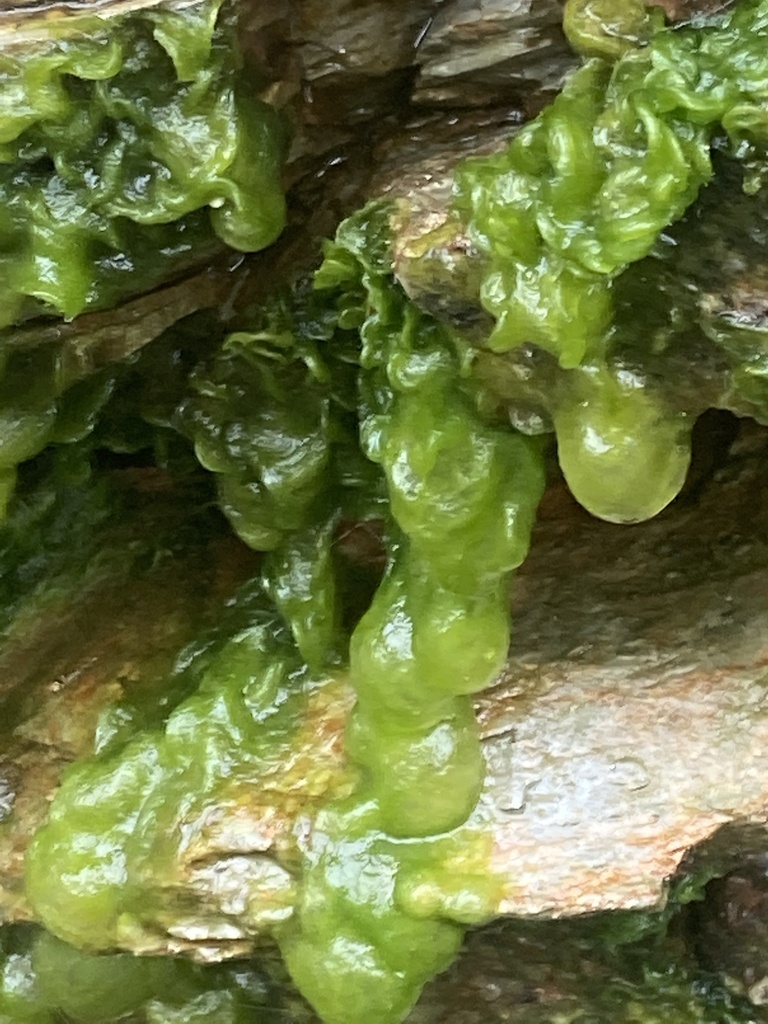
Chlorophyte on seep, Conanicut Island, Jamestown, Rhode Island, 24 June, 2024.
Phycology in Rhode Island.
Phycology is an amazing hobby, as it can practiced basically anywhere there is enough water to sustain life. Algae can grow in the bleakest puddles (Wang, Yuyao, et al, 2024), in the snow on top of mountains (Zhang, Xiaoli, et al, 2020),or even inside of rock in Antarctica (Mergelov, Nikita, 2020), and their collection and study can be inexpensive.
In Rhode Island, the Coastline is easily accessible to essentially everyone in the state,
The most basal algae are cyanobacteria, gram-negative bacteria whose earliest fossils date from around 1.75 billion years ago, from chert in Australia (Demoulin, C.F., Lara, Y.J., Lambion, A. et al. Oldest thylakoids in fossil cells directly evidence oxygenic photosynthesis. Nature 625,). They are extremely common organisms, found on every continent and seemingly anywhere there is freshwater, and even within rock. They can grow as filaments, or as singular bacterium, and often species do both strategies (photo to come). They, as far as we know, are the earliest oxygenic photosynthesizers, as in organisms that use oxygen in the process of photosynthesis. They are are also responsible for the earliest large organic structures as well, in the form of stromatolites, sedimentary rock struc
Collection Trip 1-California
The first documented collection trip on this page dedicated to Rhode Island will be about my trip to California. While I have done other trips to our local beaches, this trip has been better documented, and shows better how easy this hobby is.
The first stop for collecting algae was at Shell Beach, San Diego. The area was essentially a beefier and less walkable East Greenwich, we are missing nothing by not living on the West Coast.
The materials I brought with me for the actual collecting were
- A plastic bag
and that was it for the actual collecting materials. As long as you don’t mind touching algae, you don’t need gloves or anything else, as unless ingested, almost all algae are safe to touch. A notable exception is the masses of decaying seaweed on beaches, particularly the red tide washups or the sargassum washups, as both release potentially harmful chemicals into the air, and you should avoid digging into them for an extended period of time.
** An important note relates to law about collecting. In Rhode Island, no one will bother you for collecting seaweed or most other forms of algae, and it is a protected law in RI that you can collect seaweed from anywhere ten feet above the high tide line,
If you decide to collect seaweed from other places, make sure to check their local laws too.
In California, they have relatively detailed laws about how algae can be collected. However, they label algae as “marine plants”, because they did not do their homework. They have laws about cutting as opposed to snipping, so that algae can regrow from their holdfasts. Important to note, there is no collecting of algae from marine reserves
https://wildlife.ca.gov/Conservation/Marine/Kelp/Recreational-Harvest
However, this extends to only those organisms who are attached to a substrate, if its on the beach already (what Rhode Island Law refers to as the Wrack line), then it is fair game.
 Rhode Island Naturalism